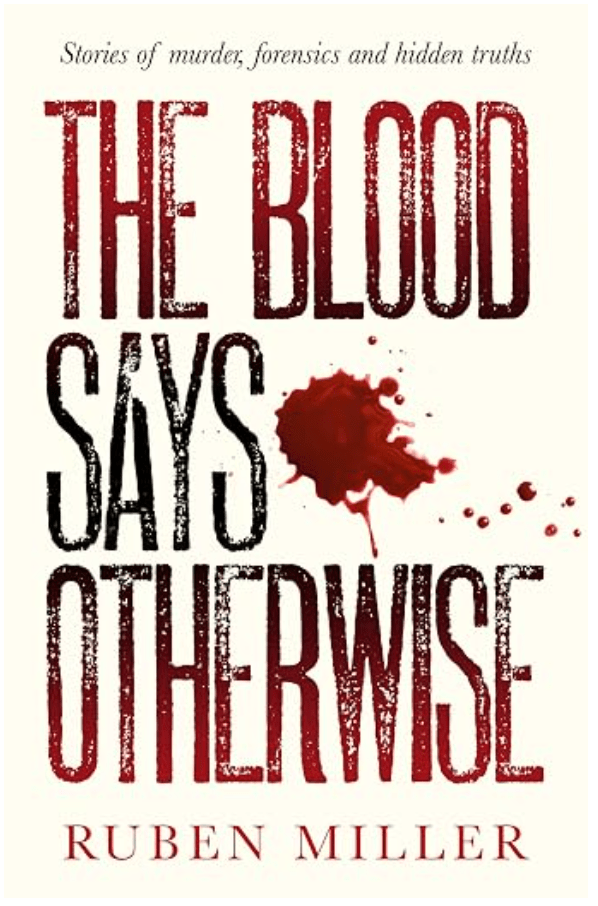
Ruben Miller is a New Zealand forensic scientist who spent 23 years working on the front lines of forensic science, including crime scene reconstruction and case management. Now working independently, primarily with the defense, he is also the author of The Blood Says Otherwise, a book reflecting on the science, human impact, and psychological realities of a long forensic career.
In this episode we talk about:
- How writing The Blood Says Otherwise emerged from therapy and from finally having space to process experiences and emotions that had previously been compartmentalized.
- How workplace culture can unintentionally reward suppression.
- The profound difference between representations of death in fiction and true crime and the lived experience of encountering a dead body.
- How curiosity, creativity, imagination, and becoming absorbed in the practical work of reconstructing a crime scene helped Ruben function around traumatic material.
- How his relationship with the media changed over his career.
- Why forensic scientists should be more willing to entertain alternative hypotheses, reconsider evidence as cases develop, and accept challenges from the defense.
- How Ruben hopes the next generation of forensic scientists will enter the profession better informed about its realities, more willing to ask difficult questions, and better equipped to sustain themselves psychologically over long careers.
Ruben’s website: https://www.theforensicscientist.com/
Ruben’s email: ruben@theforensicscientist.com
Ruben’s book, The Blood Says Otherwise (2026)
Notes from the start:
***
Do you have a suggestion for a topic on the Scattered podcast?
Do you have a question about working with human remains?
Drop Yvonne a line at ykjorlien@gmail.com
Transcript
Yvonne: So, Ruben, thank you very much for coming on the podcast. Take a minute and please introduce yourself and tell us who you are.
Ruben: Thanks, Yvonne, or Kia ora, as we say in New Zealand. I’m Reuben Miller. I’m a, what am I currently? I’m a forensic scientist still, even though I’ve been labelled many times as a former forensic scientist. I guess once you step away from the front lines, you’re no longer visible. So, therefore, you must be former.
I spent 23 years at the front lines of forensic science in New Zealand. So, that’s working alongside the New Zealand police. We have independence there, although there is a strong relationship.
I’m not a police officer. I worked for a Crown Research Institute, which held the forensic contract with New Zealand police. And so, yeah, I was a crime scene reconstruction specialist, but also a case manager.
So, basically, the first port of call for forensic examinations. Whether or not a crime scene was attended by us, I would also manage the receipt and strategic examination of items related to criminal investigations, and basically a harvesting process, and then manage the transfer of those samples to various analytical labs like physical evidence, which is basically a chemistry-based lab, drugs, forensic DNA, and so on. And then it would be sort of an oversight process, working very closely with police around the questions that needed to be answered and how could we best answer them.
So, a very generalistic approach, but crime being crime in New Zealand, which is not huge, I had to be good at everything. It wasn’t until several years into my career that I realised that I was operating as a specialist within each of those categories when compared to international standards. An interesting job that kept changing as a result of that, and one that was very fulfilling, until it wasn’t in weird ways. I left two years ago for various reasons, and I find myself in a place where I’m operating as one of only a couple of independent forensic scientists in New Zealand, offering services to the defence as opposed to the prosecution, which was very much the case with my previous job.
Yvonne: And you wrote a book.
Ruben: Oh, yes, that. I guess I’d never diarised or journaled before, which is quite trendy these days. I’m assuming not so common amongst slightly emotionally suppressed men, which I would definitely have put myself in the category of.
And yes, I came out of that frontline career and thought I’ve got to, I didn’t know it, but I was probably journaling for the first time and it just became a book. So, forensic stories became, yeah, the stories that sit underneath the stories, I guess.
Yvonne: So, I’m just going to dive right in, you know, because, what the heck. So, did that journaling practice come from the therapy that you started when you were still a practicing forensic scientist?
Ruben: Yeah, it did towards the end, definitely. I mean, I had dabbled with writing a number of years before, and I think that was out of a frustration of not being able to be particularly creative with my statements or reports for court. I constantly got pulled up for flourishes and flowery language earlier in my career, and I just suppressed the hell out of that.
And I think there was a bit of a liberation when I went through this, I guess, emotional turmoil talking to therapists actually about, you know, not the science, not the black and white, but the shades of gray and the shades of gray that existed in me. So, because I had started writing, but then it shelved it because I didn’t know what the hell I was doing. When I came out of there, when I started therapy and then I left work, it was, I just had space to breathe for the first time in more than two decades.
The casework disappeared, and I just thought, oh my God, there’s other stories I desperately want to tell, or at least for myself, because at that point, you know, the possibility of a book was very, very distant. Yeah, so, yeah, therapy certainly assisted that. If for no other reason, then I was just talking not about science anymore.
Yvonne: What else did you learn from, I guess, engaging in this: the writing that you had suppressed for so long? Because it sounds like it was more than just creative expression. Just before I hit record, you were talking about being in this very rigid and rigorous environment of not just science, but forensic science where the stakes are so high and you have to adhere to rules and structure. I mean, that can suppress anybody’s creative expression and freedom, frankly. So, I’m just wondering, if anything else came, happened, or, maybe broke open inside of you when you engaged in this, engaged in the writing.
Ruben: I think it was, yeah, I’d experienced a number of mini and slightly larger crises along, sort of, particularly the last five years of my career. And because I was so good at just suppressing and avoiding those, the emotions that came up alongside those, I think actually to have that crack right open and, sort of, liberate the contents of those compartments, that came from compartmentalization, it so much ended up spilling out. It was actually one of the biggest impetuses, impeti, for wanting to write certain stories was the exposure to ways of living over the years. The tragic circumstances that people find themselves within and that I had, sort of, almost like this ticket, this strange ticket to go and visit. And that was really confronting. And I’d obviously been, sort of, playing around with that over the years, but at a very, sort of, rudimentary level. And then I just put it away because it was actually getting too stressful or just quite traumatic. And to have that, sort of, lid popped off meant that I could suddenly start articulating a number of those experiences and emotions. And it was freeing.
It was, yeah, it was quite profound.
Yvonne: So I’m wondering about your training because in anthropology, archaeology, we’re not really, especially if we want to go into forensics, it’s usually an applied aside. You know, you got to do your foundational training in anthropology, archaeology, and osteology and whatever. And then the forensic side of it is an aside. It’s like, oh, you want to do that? Well, that’s kind of, after you graduate and where opportunities present themselves. There are very few places in Canada that train forensic anthropologists.
So all that to say that training for, I guess, the rigors of forensic work and also, working with police, working with media, working, you may encounter, families next of kin. None of that was in my training, at least. I don’t know if it is nowadays. My training, you know, is 20, 25 years old. So I’m wondering about your training. Were you prepared for any of that?
Ruben: No, I learned how to enhance a bloodstain and how to write in certain ways. But I hadn’t, no, none of what you said, I was trained for in a formal way. I think it was expected that anything relevant would be discussed and absorbed somehow, subconsciously, osmotically, through team culture, whatever it was.
But that didn’t happen for me either. So none of what you described, anything that would sort of border on an emotional impact, media, families, relationships, anything like that, not at all.
I mean, I think it went a little way into the court side of things, giving expert witness testimony, and it was, but it was still very strategic around how do you not make yourself look like a fool rather than actually, you know, this is going to bring a lot of stuff up and what do you want to do with it?
So signs and signals and warning signs, I would say that’s where there wasn’t much.
Yvonne: And I’m wondering why that is, because it’s not like you’re going to be on scene alone. It’s not like you’re working in isolation. I mean, that’s part of the reasons why cases get solved because of teamwork. You’re working together. And especially nowadays where there’s a heavy reliance upon forensic evidence. You need these specialists, these analysts in certain areas, which you can rely on to do their job, to become experts in certain areas.
And they give you, the team, the information that they need to go, the investigators, they need to go back. And then it’s another piece of the puzzle. So they can hopefully solve the puzzle.
Ruben: When I joined, so this would have been 2000, we had a self-organizing team. So a flat structure that was wholly made up of scientists. So, we’re just in a rinse and repeat cycle really.
And so management set sort of quite far apart from that. And we were left operationally to make all sorts of decisions ourselves, within reason. And so every single one that I could point to in the team had gone through some version of a master’s or a PhD program and then had moved into science and then moved into forensic science or directly into forensic science.
And more and more, the younger staff were coming straight out of the forensic master’s program at Auckland University. They had seen what lies ahead and they were very strategic about what to do to maximize my chances of getting a job. And then you’re moving into a team that’s mostly populated by people who’ve done exactly what you’ve just done.
And scientists can’t help but reduce things down in my experience. You know, what can we answer? What can we not? And emotions just seem to be a pesky thing that got in the way of all that. So, team culture is everything. And if it starts out in a certain way that’s not particularly healthy, then what are you going to do to change that? Especially when all the new recruits want to do is desperately fit in and be very conscious of what’s going to trip me up or what’s going to hamper my progress. I’m struggling with this and no one prepared me for seeing a body. And then the next week seeing another body and then another body. I can only speak from my personal experience and that’s not what strong people do. So let’s shove it all down and move on. And I didn’t see anyone doing anything differently.
So that just confirmed for me that that was the right thing to do. Yeah, so I would say that what needs to happen is that it’s not necessarily for a mentor or a trainer to provide psychological advice. And I think that’s what a psychological outlet would be for. But the preparation and the warning that could sit there rather than the discouragement. If you’re a young doctor moving into the field, you can be hit with a warning that you’re going to lose some of your patients. That’s just a reality check and something that you could then do something with. With ongoing support. But it just doesn’t really exist in this world for some reason.
Yvonne: Yeah, and I find that interesting. I mean, even just to normalize it, to say that you will encounter some situations that may hit you emotionally hard.
Ruben: Yeah.
Yvonne: Just to know that when it does happen — because it will, it’s not an if — when it does happen, you can say, okay, I was warned about this. This is normal. Instead of thinking, holy shit, what’s wrong with me?
Ruben: Yeah, what’s wrong with me? Yeah, and it must be my fault that I’m reacting in this way. I mean, that’s certainly right.
If you imagine having a team leader who would stand up in front of a group and say anything along the lines of this was my day last week, you know, and I struggled with this, this, this. Not to make it a trauma dump, but to actually just indicate that, as you said, this is normal. What do I want to do?
I want to be like that guy or that woman, because they’re the people that I went into this industry to emulate. And well, okay, immediately, I’ve got permission to be able to talk like this. And what that does is a top-down culture change where certain conversations are normalized.
But when you’ve got a robot at the top who’s fixated on case details and forensic strategy, and that’s all you hear, then that’s entirely in line with the training program you’ve had, and it all makes sense.
Yvonne: Right, because actually, I was even thinking back to–so your book, let’s just introduce it first, because I don’t think we’ve done that. The Blood Says Otherwise. We’re just going to, you know, run right into the thick stuff and forget about the good stuff.
The Blood Says Otherwise, right at the very beginning, you talk about your, I guess, first life as doing makeup effects in movies, and how you were actually quite surprised that that didn’t really prepare you for dealing with the dead.
Ruben: No, not at all. I mean, I thought I was well prepared, and I almost thought I had a little secret that the other students who were vying for the few jobs that would come along the year that we were on sort of placement, for want of a better word, doing our theses, they, yeah, I thought, I’ve got a little upper hand here because I know what dealing with blood and guts is like, having chucked around fake blood and guts, principally through Europe on a very strange little career.
And, coming back years later and being at the end of my course and thinking, okay, so how can we confirm to ourselves that we’re prepared for this as sort of an organized trip to the morgue just down the road? Because it was the only place I knew where bodies would be freely viewable. And yeah, so we joined along on a sort of, I’ve said it before, sort of like what feels now like a bit of a depraved show and tell, but we were sort of giddy and excited.
And was I feeling giddy and excited? I was, but I was also nervous, but sure as hell wasn’t going to show it. And then, you know, we were led through the bowels of that building by a technician and then handed over to the pathologist.
And she had three bodies on the go. And I think there was a bit of exposition there and almost celebration of the craft. So there were definitely flourishes and embellishments.
And yeah, I lasted all of about five minutes into the first procedure because it was bloody awful. And, you know, in hindsight, I realized it was because I was standing around. But, you know, I didn’t make it past what I remember as being sort of gardeners, loppers being used to crack open the rib cage. And whether they were loppers or not, it was sort of beside the point. That was my memory.
And yeah, I got led out and I had to sit up there in my shame in the pathologist offices, just waiting for everyone else to finish off their demonstrations. And I thought, that’s it. That’s my career gone.
But, I put a different strategy in place, which was just, okay, this is my opportunity to start my suppression, I guess. It wasn’t conscious, but it was like, let’s just shove all that aside and carry on. And what else can I do to maximize my chance? And that’s, well, I don’t talk in this way. I don’t feel in this way. I don’t do in this way. And I will be, I guess, looking back at it, just a bit more of an android about it. And it’s not to cast dispersions on anyone else going through the same path. It’s just what I can now reflect about myself.
And yeah, I just went into denial in my interview that came up a couple of months later and answered in the affirmative when asked about how would I deal with the more gruesome aspects of the job? No problem. I organized a trip to the morgue for a bunch of students here and went swimmingly. And the one thing I didn’t write is in that interview, I saw the interviewer’s notes. And they can write their thoughts around the quality of my answer. And one of the interviewers wrote in capital letters “RESILIENT” in that box.
And so what I learned there was denial and suppression will get you everywhere. It was the most brilliant confirmation that I needed to just carry on in that vein, which is what I did.
Yvonne: Wow, that is really pretty affirming. Wow.
Ruben: Yeah, yeah.
Yvonne: But you have to give yourself credit for at least trying. I mean, even if your training didn’t warn you about what you would encounter, you organized a trip to the morgue. I did the same because I knew I was looking ahead. And it’s like, if I can’t handle this now, then I might as well just give up. But you didn’t know what you continued on anyway.
Ruben: Did you handle it? And what was what was?
Yvonne: Yeah, actually, I did. I was there with was it three others, I think. And yeah, I had my nose right in there. It was pretty weird. But yeah.
Ruben: So you went into a career and with one experience, and I went into a similar career with a very different experience. What were the mechanisms that allowed us to do that? Mine was definitely honing something very particular. And, for me, it was a survival technique.
Oh, look, don’t get me wrong. You know, what a wonderful career in so many ways. And, science, science is bloody cool. But yeah, I just wish my innate sense of curiosity as a scientist, I could have applied that to myself as well. At that point, that’s the biggest change I would have made.
Yvonne: Yeah, well, you know, shoulda, woulda, coulda, right?
Ruben: Yeah, absolutely. Otherwise, I wouldn’t have been in this position now, writing, written a book and blah, blah, blah.
Yvonne: Yeah, yeah, exactly.
Ruben: Yeah.
Yvonne: But I’m, I’m curious about, maybe it’s the differences or what you — because I’m trying to put myself in the minds of maybe the true crime people who watch a lot of TV, they’ve seen photographs, they’ve seen dead on TV, they’ve seen reconstructions — you saw, you were making the makeup for the dead….
Ruben: Yeah.
Yvonne: …how all of that is actually really different from the experience of encountering a dead body? For me, it was the smell.
Ruben: Yeah. I, to be honest, there is nothing that… I write about it in the final chapter of the book. When I’m examining, well, I think I’m examining a young woman on the side of the road. And it’s, I try to write about the difference between a body that’s sleeping or alive and a body that’s not. And there’s always a tell when the eyes are open, or at least partially open. There’s nothing like a dead body’s eyes.
And that’s very, very disconcerting. And that I have never seen replicated in any sort of dramatization or work of fiction. There are qualities, almost unexplainable qualities about the skin, about the fingernails, about the hair, that sort of, that sum total says to me, at least very clearly, this person is no longer alive.
And I had never encountered that in the same way. I dealt with a couple of experiences of death in my teenage years, but it was very fleeting, and including an open casket sort of funeral experience, but nothing where I was able to stand and observe in that way. And I think voyeurism, I guess it was part of my process there. And as I was just standing and watching and just soaking it all up, which with no job to do — which I go to on to explain in the book was the worst thing I could have done. But, I guess true crime is a version of ultimate voyeurism really, isn’t it? It’s sort of like this gateway to somebody else’s experience trauma, worst day, whatever you want to call it.
But, I think when it’s a body in stark isolation like that, where there is no narrative, there is no story, there is no DNA results by the ad break, context then becomes everything. And we don’t have a usually, well, not always have this tidy resolution. Everything’s black and white. A suspect is apprehended. A culprit goes away and we are very satisfied with a job. Well done. Let’s move on to the next case. All of that makes it palatable and digestible and titillating and interesting. Whereas we know that real forensic science and real investigative work doesn’t work that way.
Yvonne: Yeah, very much so. It’s very different. It’s, in my experience, it’s, a lot of patience is required. Yeah.
Ruben: Yeah. There’s the mind of the killer as well, right? Sort of, what do we need to do to entertain alternatives? We need to get in there and play around. And that can be really disconcerting as well. The deeper we go, the harder it is — at least for me — to have gotten back out and for that not to actually affect aspects of the rest of my life.
Maybe I was just not good with my boundaries, but I was very willing to go very deep into, scenario creation and imagination. So that was that may be in the end tripped me up as well.
Yvonne: I have to say that reading that in the book, I was very impressed that you were able in the moment and within the context to connect the dots of all of these indicators — whether it was blood splatter, whether it was an item found, an item of furniture turned over — able to connect the dots so that you could, like you say, enter the mind of the perpetrator to figure out where more evidence might be. That was pretty amazing to me because it, I think it takes a certain type of person to be able to think that way in the context right then.
Ruben: And I may — thank you for saying — and I haven’t really ever thought about it that way, but I mean, maybe some of that has to do with, not only did I suppress certain things, I thought that I suppressed my creativity in this job because I’ve entered into science and I’d left aspects of what was a creative career in the past. And, but I think maybe a lot of that came with the creative mind that needed an outlet. And, so, for better or worse, it was going as deeply as I could.
And, I think I also, I envied detectives a lot and the job that they had. So I was never going to limit myself simply to, okay, here’s an isolated group of stains. Let’s do what I can with that and go away with the samples.
I always was compelled to think much more laterally. And that was the benefit of, or at least the opportunity that being a crime scene forensic scientist with a very broad range of techniques and skills at my disposal allowed. So in that sense, I was quite fortunate in I could have been a specialist in a lab doing fabric damage and impression marks, but I wasn’t that I was offered an opportunity was tantamount to, okay, what is this scene saying to me and what do I want to do?
Yvonne: But it sounds like in the book — because you describe your first day out and your trepidation about being around a dead body because you know what happens around with you around dead bodies and how are you going to navigate that — and then it sounds like, from what you say in the book, that something just switched on and that you entered this state where you were then able to connect the dots which eventually did bring you back to the body and suddenly you’re there and “hey, wait a second nothing’s happening” but you were able to enter this state. So it sounds like there was some sort of natural inclination that allowed you to do that.
Ruben: Absolutely. And that in a very simple way. It was being busy. So we don’t want to take that away. It was having a job to do, having a purpose, not in that sort of observer state only. And it was actually genuinely being fascinated and absorbed by what I was doing and this opportunity to put all this training together and, I’d probably — I was going to say despite a lot of failings that I had — I also had a high opinion of myself, which is probably a failing as well, but it serves occasionally to say, “Okay now I can do this. I have all this training. I’m in this situation. I can work it out.” Maybe that’s not a high opinion of myself. Maybe that’s just being confident with my skills. And it was glorious to start putting that all together and get my imagination going and to visualize the actions that may have occurred to produce the forms of evidence that I was seeing. And a picture just kept evolving, and that just completely took me away from any ideas of traumatic exposure or anything.
So it was that was a wonderful thing. And it was also a thing ultimately that added to my repertoire of, I guess you could argue, coping mechanisms because it was it was a distraction from something else that I probably needed to engage with. I mean, it’s not a this or that; it’s all those things. So how could I stay curious with everything
Yvonne: Yeah, and I think it’s like with everything: in moderation, right? Because even the most happy beneficial flow state, it’s got to end at some time you can’t stay in it forever
Ruben: No, no, that’s true.
Yvonne: So I was wondering if we could maybe backtrack a minute and because — so we talked about your training and interacting with the families and with the dead and I’m wondering about interacting with the media — because you mentioned on the Between Two Beers podcast that media can be vultures, I think was your word. I’m not going to dispute that. I mean I’ve been warned about the media and it was outside the context of my training and I’ve had my interactions with media as well. And I understand their side of it. They’ve got a job to do. They’re under tight timelines. They’ve got to perform, get the some sort of story, whatever. But it’s the way they go about it. And in your book you there’s this kind of evolution about the way you interact with media and I’m just wondering…I’d like you to talk a little bit more about that: from you know consciously engaging media at the beginning is maybe a coping mechanism towards later where you were avoiding them flat out.
Ruben: Yeah, yeah. I those first few years were exciting years and I felt the attention that media gave me was exciting as well. Very quickly I was very unpreparedly going to high-profile homicides as a technician. And there were media at most of those. If you’re thinking downtown Auckland or a large city here in New Zealand, it would just be, it’s easy access.
I think media have a good relationship with the police. Police don’t want to exclude media because it can be a tool as well. It’s normally negotiated. And then you would have a bank of photographers and camerapeople with reporters waiting behind the police tape at most big crime scenes.
And, to be honest, I liked it. I thought, “Wow, this job is turning into so many things that I thought it would.” It’s a cool job, so people are interested. I got a lot of attention at social gatherings and so on just because of my job title, and the media reflected that as well and just validated it. So I played around with it but in a way that most of my colleagues didn’t at all. On reflection—and I talk about this in one of the chapters of the book—the playing up to the media was also a bit of a distraction from, at times, what was going on. I thought it was interesting that I did that when there was a real lull in proceedings. There would be more like the standing around that I experienced in the morgue, and that’s when things maybe didn’t go so well. When I had a job to do, I’d be almost oblivious to the media.
But I think what changed as I went through my career is that I was being exposed to so much more, and I started having questions about people and their environments, the nature of criminals and criminality, and punishment and justice, and all those things that I was getting more and more involved with—especially as I was promoted, and giving evidence in court, and having more interactions with lawyers, defense lawyers, prosecutors, victims and suspects, and ultimately offenders — that had some real questions around why people do the things they do, and this distilling down to our worst behaviours and “Bad people do bad things,” all of those ideas. “There are evil people out there.” Because it’s easy, and it others people and makes them not intrude into your own world.
Through a whole bunch of experiences that were quite formative, I started to look at the media as, at times, being a bit of a problem-creation around having a relationship or doing their version of playing into that narrative. Stories just became headlines, and journalism just became reporting. It was just either reporting the facts as they knew it, or waiting around for that one gratuitous shot of a body being moved into a hearse. And that was the only real interesting aspect of the story in the media, and therefore in the public’s eyes.
So it started to pervert this idea I had of why people do what they do and any interest in that, and the human aspects underneath the headlines. I started to view the media as being really culpable in that, often, and then just actually rejecting it and wanting nothing to do with it.
As you know, I probably used that word “vultures.” I’ve also used “rats” and various other terms. I don’t think that’s necessarily the case now. I write for a slightly alternative media source here, and I’m much more engaged with journalists and media from a different angle. I can really understand that everyone’s a human and that most people are just doing their best.
So I’ve definitely tempered that view, but I do think there’s a lot of room for change.
Yvonne: Yeah, you’re right. I never thought of that before, but they do contribute to the narrative of the othering. Like I said before, just get the story, get the facts, get it to the deadline, and make your copy for whatever platform it’s going to be published on.
Ruben: I think if you don’t have much time, “bad person doing a bad thing” is much easier than trying to find something juicy underneath that that actually tells us something about ourselves or where attention could go—which I sort of think is real journalism. It’s like, “Well, what’s the story underneath your story?” And that I see very rarely.
I had a beef with a court reporter, a crime reporter, about this very fact. Because what was coming out of a trial, it’s like, what is the public good there? What are we trying to say when we’re exposing details about how somebody died to the public? What do we learn from that? Well, if we go deeper, maybe we could learn something, explore something, or be curious. But if we just stay at the surface, we’re doing our own version of contributing to, if you want to call it, the CSI effect, or public perception about what constitutes interesting crime. And then we get back to true crime and documentaries and sensationalism.
Yvonne: Yeah, and this whole romanticizing of crime and forensic science.
Ruben: Absolutely. As much as we demonize people, you also get hero status going, as well, with the lone forensic investigator who can do the job of ten people, à la Horatio Caine.
So, yeah, I think we’ve got a pretty warped perception at times, and we just need to look at why that might be and what constitutes entertainment.
Yvonne: So you mentioned that you’re now freelance. Are you contributing at all to, I guess, the next generation of forensic scientists coming up through the pipeline?
Ruben: Well, unfortunately, New Zealand is a very— I did say that my previous employer has a monopoly on forensic science in New Zealand, and they do — however, I have had a little bit of a platform given to me through the book and some of the media exposure, and I’ve had a lot of students actually reach out to me. I like questions from students. They’re at the beginning of their career and they’re excitable, and I’m old and washed up, and it gives me a bit of excitement back. So, in that sense, whatever platform or opportunities I’ve been given are an informal route to some level of influence or inspiration.
But until the industry is a little more balanced, and there are more experts out there who are supportive of the, I’d like to say criminal justice system as a whole—which is maybe a sorry way of saying I’ve moved to the defense—but there seems to be very little opportunity, aside from a major institute, for someone to practice forensic science except for being on their own. So that’s one of my goals is to set up an independent practitioners’ network where this stuff can exist.
Yvonne: So what kind of questions are these students asking? Or maybe what kind of questions would you wish they asked?
Ruben: Well, three students have already asked, “Is this really the reality of going to crime scenes in New Zealand? Because I didn’t think that was the case, and I now am questioning my career.” Initially, I felt a little bad about that, and then I thought, well, if you’re hit with a little bit of the reality and you’re questioning your career, all power to you. I think maybe you should be informed.
In some ways, I’m doing what I’m arguing against. I haven’t picked the most sensational cases for my book, and that was intentional, but I also haven’t picked the dreary, day-to-day, low-level crime stories that have gone nowhere, because that would have made for a kind of boring book. So I’m elevating the perception of what forensic science is, and maybe I’ve elevated this idea of the effect that forensic science, or the exposure that comes with the job, can have as well. So I have to be a bit careful that I don’t go a bit one-note.
I’ve got the impression that they’ve have gone back with more questions for their lecturers, to their future colleagues, to their superiors, all that sort of stuff, which I think is fantastic. The more of that that’s created is great.
I wish there would be a greater engagement with context and judgment when it comes to forensic evidence and its meaning within a greater investigation, rather than an almost siloed approach to, “I will answer these questions very early on in an investigation, and they won’t be revisited prior to trial in any meaningful way because basically we’re running out of time and we haven’t had defense involvement until just prior to trial, so we don’t actually know what these alternative hypotheses are that we’re supposed to have been entertaining.” So I think a greater keenness to understand the case from all perspectives, rather than what can become a tunnel-visioned one occasionally, and at times a rigid defensiveness of the forensic results that tends to happen under a prosecution-only system. “I’ve spent a long time at this crime scene. I’ve come back. I’ve done all these examinations. I found these results, and you’re telling me that they’re now being challenged?” It’s like, yeah, they’re being challenged, and that’s okay. I think a slightly more expansive approach to being challenged, to having questions put to you, and to thinking about things in a slightly different way—especially as time goes by—could be a really really healthy thing.
I think that’s what working, quote-unquote, “with the defense” has taught me the most is that you don’t know what you don’t know. And if we’re not going to ask those questions at any point, then we have a static set of results that make their way to court and don’t actually answer the pertinent questions.
Then we come into a whole bunch of ideas around the CSI effect and whether it’s appropriate for forensic evidence to even have a role in a particular case, but that’s a different question.
Yvonne: I’m just thinking, isn’t that—I don’t know if it’s the scientific method in particular—but to entertain alternative theories, or at least alternative paths to get to your hypothesis. You have this evidence. Okay, well, is it just this one path? And then, if it is that path, can you replicate it? I don’t know. That just popped into my head.
Ruben: Yeah. And I think the greater context is that—you’ve got to call a spade a spade here—I would say that more than 90 percent of people who are accused of a particular crime are 100 percent guilty of that crime. That’s just anecdotally, that’s also looking at the outcomes, and a big part of that is my gut. So this is not me the scientist. This is me going with the gut.
But you can’t remove the human from the scientist, and we all broadly feel this. So we’re on the side of truth and of reality when we’re operating as a forensic scientist alongside the police, attempting to catch bad guys, because that’s what the police ultimately are doing.
You could reframe that in a healthier way, and it probably would make a lot more sense and would be great for people to hear that because it would be a little more neutral. But fundamentally, some of that exists behind the scenes.
Then you fast-forward three years and get an annoying defense lawyer asking some annoying questions on behalf of a client who you’ve already convinced yourself is guilty. Those are not the alternative hypotheses that a scientist traditionally expects they would have to incorporate into their examination and interpretation process. It’s kind of like a petty challenge.
But they should stand up. They should be entertained, and they should be treated with equal weight, in my opinion, if for no other reason than it’s making one’s evidence, or interpretations, or conclusions as robust as they can possibly be.
We don’t always have the luxury of asking ourselves those alternative hypotheses early on in an investigation. If we haven’t, and we’ve just sort of gone through the motions—which does happen—then let’s be rigorous prior to trial.
Yvonne: Right. Agreed.
Ruben: And part of this is a timing issue, and it’s a resource issue. You have a defense lawyer who, I’m just going to say it, knows nothing, is defending their client to the best of their ability, but is only as good as their resources and their access to expertise.
At times, it’s laughable, and that’s not helping anyone.
Yvonne: Yeah. All right, we’ve gone deep on a few things.
Is there anything that you wanted to end with? Do you have a message, or do you want to end on a happier note? I don’t know.
Ruben: Yeah, I mean, this is the way it goes, right?
My book is 90 percent forensic science and 10 percent the stuff that sits at the edges, and people definitely remember that 10 percent. It’s arguably the juiciest stuff.
I see a lot of hope around me, which is really lovely. I work with fantastic lawyers. I work with fantastic police. I still have relationships with police. I unfortunately don’t have too many relationships with forensic scientists in New Zealand, which is part of the issue that I described. But I do have contact from students, and to see a new career through their eyes, and how things could be tweaked and done slightly differently, would make for the most amazing journey.
I have entertained re-entering the profession, even in a frontline capacity, a few times, and it’s just—I’ve done my dash. I don’t need to do it again. However, I have a whole bunch of tools now that I think would mean I’d do this career differently. Not less successfully or more successfully, necessarily, but in terms of management of myself, and my exposure, and the way I operate, I think it would be infinitely better.
So if we can inject some of this throughout the process for people, then it would just be invaluable, I think. We want these people to keep doing their amazing jobs for as long as they can, so experience is not just left by the wayside—which is often what happens. It’s this attrition, or this inability to sustain, and then we lose our most impactful people. In small industries, there’s no place for them to go easily.
So, yeah, I do have hope. I am now stepping outside science itself. I’m working with a foundation that is New Zealand’s biggest rehabilitator and rehabitator of serious criminals. They’re out on probation, and I’ve listened to their stories, I’ve talked to them, and it just further opens my world around humans and understanding and compassion. Not atoning, but making things much grayer and more nuanced and interesting as well, and creative. That’s been such an amazing part of this journey. It’s basically the people contact and how crime touches various people. A lot of it is not happy and peppy, but it is real, and there is incredible beauty in it and a lot of inspiration.
So that’s what I love. That’s sort of where my heart is. And I love aspects of keeping forensic science honest and fair and well interpreted, and existing in that space. I’m not perfect by any means, and I’m learning a lot through the process.
Yvonne: Oh, wow. That just sounds amazing. Best of luck to you on that path. It sounds really great.
Ruben: It sounds really good when I say it.
Yvonne: It sounds very human. Yeah. I think you’re doing the exact opposite of othering.
Ruben: Yeah. People often think that science and creativity sit at opposite ends of the spectrum, and I really don’t think they do at all. That’s what I’ve learned now, when I’ve integrated all this stuff. The best forensic scientists—and I’ve met many of them—they’ve been endlessly curious. They ask crazy or unusual questions, and they notice things that other people don’t. They’re really comfortable changing their minds when new things come along or new evidence appears. Those are inherently creative qualities that we need so much more of in forensic science and, indeed, in criminal investigation generally.
So it feels inspiring that it doesn’t have to be the cookie-cutter, black-and-white, “I’ve always been good at science, so I’ll move into forensic science.” It’s not just those people who can make real differences in this industry. It’s the real creative types that aren’t necessarily drawn to that, but we need more of.
Yvonne: Which leads us to the question: can people reach out to you?
Ruben: Oh, totally. And, as you’ve experienced, I will get back to them because I really love talking to people.
They can follow me on social media. They can send me an email: Ruben@theforensicscientist.com. That’s hopefully easy to remember. They can go to my website, http://www.theforensicscientist.com. They can see what I do. They can make suggestions, corrections, engage in commentary, or heartfelt communication. Any one of those is fine.
Yvonne: Ruben, this has been an absolute pleasure. Thank you very much for coming on the podcast and talking to me.
Ruben: Oh, thanks so much, Yvonne. I’ve really enjoy it, and your quizzical and compassionate nature is a pleasure to deal with.
 Yvonne Kjorlien